
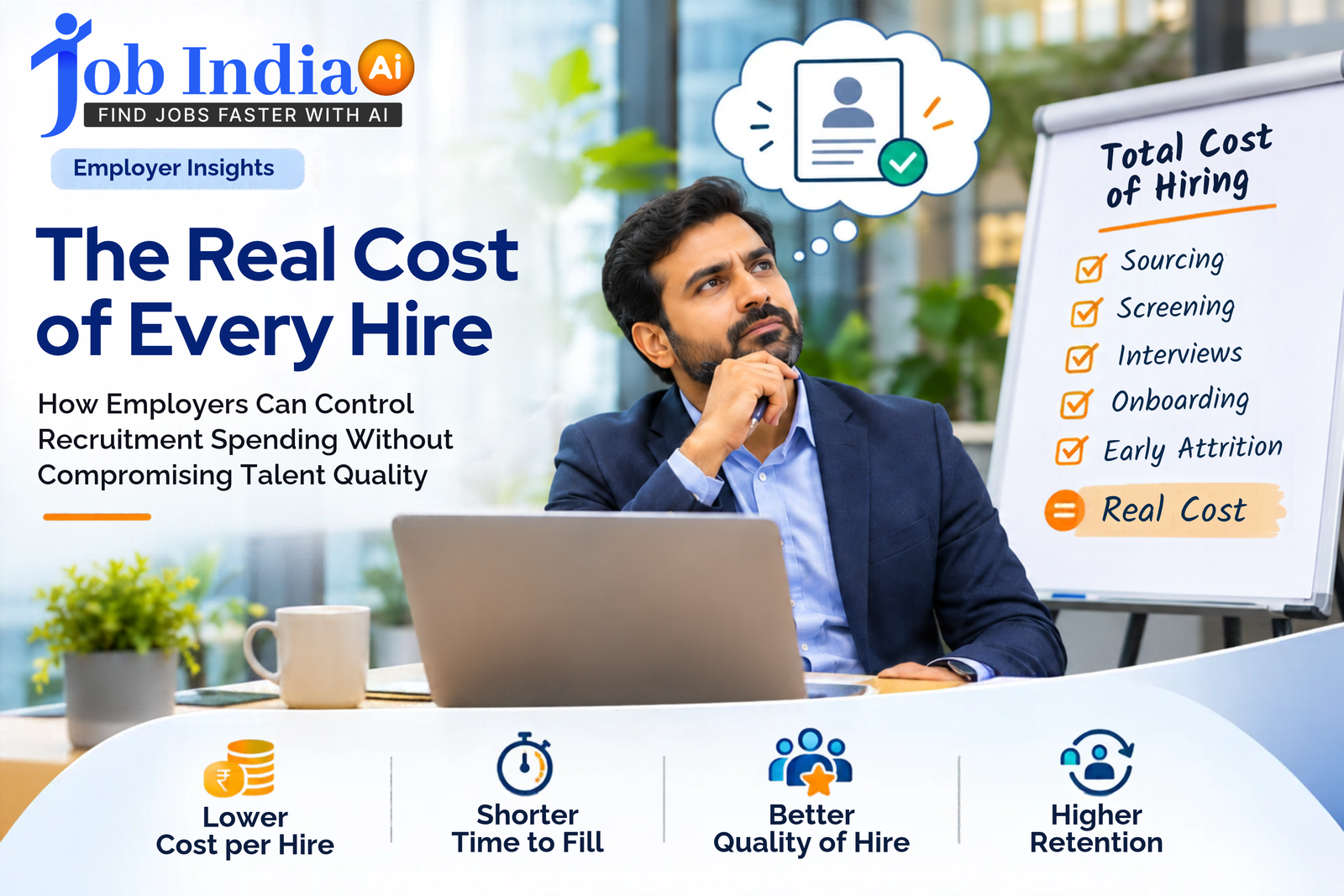
Introduction: Is Your Hiring Budget Really Under Control?
For most businesses, recruitment costs mean job advertisements, job portal subscriptions, or recruitment agency fees. But the actual cost of hiring goes much further.
The time HR teams spend screening applications, coordinating interviews, evaluating candidates, and completing onboarding also represents a business expense. Add the productivity lost due to vacant positions and the cost of replacing employees who leave early, and the overall investment becomes considerably higher.
For founders, hiring managers, and HR leaders, understanding the real cost of every hire is essential.
The objective is simple: reduce recruitment expenses without compromising the quality of talent entering your organisation.
1. What Makes Up the Real Cost of Hiring?
Every successful hire involves several expenses, including:
Direct Recruitment Costs
- Job portal subscriptions and advertisements.
- Recruitment agency fees.
- Employee referral incentives.
- Background verification.
Internal Recruitment Costs
- HR team screening and coordination time.
- Interview hours spent by managers.
- Candidate follow-ups and salary negotiations.
- Documentation and onboarding activities.
Indirect Costs
- Productivity lost due to vacant positions.
- Additional workload on existing employees.
- Training and replacement expenses.
- Early employee attrition.
Employers who consider only advertising expenses often underestimate their actual recruitment investment.
2. Understanding Cost Per Hire
Cost per hire helps employers understand how much they spend, on average, to recruit one employee.
Formula:
Cost Per Hire = Total Recruitment Costs ÷ Number of Successful Hires
For example, consider a company that spends ₹60,000 on recruitment activities and successfully hires 10 employees.
Its average cost per hire is ₹6,000.
This illustrative calculation includes advertising, recruitment support, internal HR time, interviews, and onboarding.
Tracking this figure regularly helps employers understand whether their recruitment budget is being used effectively.
3. Why Recruitment Costs Increase
Several common recruitment practices can increase hiring expenses without delivering better results.
- Unqualified applications: High application volumes create additional screening work.
- Unclear job descriptions: Poorly defined requirements attract unsuitable candidates.
- Expensive recruitment channels: Employers may continue paying for channels without measuring their performance.
- Delayed decisions: Suitable candidates may accept offers elsewhere while approvals remain pending.
- Early attrition: Employees leaving shortly after joining force businesses to repeat the recruitment process.
Addressing these issues can improve recruitment efficiency without increasing the budget.
4. Five Ways Employers Can Reduce Hiring Costs
Employers can take practical steps to improve recruitment spending.
1. Define Requirements Clearly: Establish job responsibilities, qualifications, experience, salary expectations, and essential skills before publishing vacancies.
2. Choose the Right Recruitment Channels: Compare job portals, referrals, agencies, and direct sourcing based on successful hires rather than application volume.
3. Improve Candidate Screening: Use structured screening criteria, relevant filters, and AI-assisted matching where appropriate to reduce manual effort.
4. Simplify Interview Processes: Avoid unnecessary interview rounds and establish clear timelines for selection decisions.
5. Monitor Employee Retention: Evaluate new employees after joining to understand whether recruitment decisions are producing long-term value.
5. Measure More Than Just Cost Per Hire
A lower recruitment cost does not automatically mean better hiring.
Employers should monitor a few important indicators together:
| Metric | What It Measures |
|---|---|
| Cost Per Hire | Average recruitment expenditure |
| Time to Fill | Time taken to fill a vacancy |
| Quality of Hire | New employee suitability and performance |
| Offer Acceptance Rate | Candidates accepting job offers |
| 90-Day Retention | Early employee retention |
Reviewing these indicators helps HR leaders identify problems and make better recruitment decisions.
6. How Jobindia.ai Can Support Cost-Effective Hiring
For businesses managing regular vacancies, recruitment technology can help reduce repetitive administrative work and organise candidate management.
Jobindia.ai offers employers a platform to:
- Post job vacancies.
- Discover candidates across different industries.
- Search and filter candidate profiles.
- Use AI-assisted candidate shortlisting.
- Manage recruitment activities more efficiently.
- Access flexible, credit-based hiring options.
With free basic job posting and flexible hiring plans, Jobindia.ai provides businesses with an additional recruitment channel to explore while managing their hiring budgets.
Visit www.jobindia.ai to explore the platform.
Conclusion: Make Every Hiring Investment Count
Recruitment should be measured by the value it brings to the organisation, not simply by how much money is spent.
Employers who define requirements clearly, choose suitable recruitment channels, improve screening, and monitor employee retention can build a more cost-effective hiring process.
Remember, the cheapest hire is not always the most economical hire.
The real value of recruitment lies in finding the right person, at the right cost, who can contribute to your business over the long term.
Jobindia.ai | Hire Smarter. Hire Faster.